Introduction
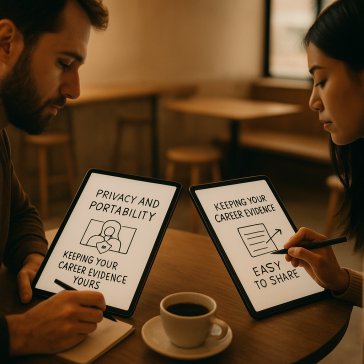
In today's fast-moving labor market, the evidence that proves your skills and accomplishments — certificates, project artifacts, employer attestations, and micro-credentials — matters more than ever. But as you collect and share this career evidence, two priorities often conflict: privacy (who controls and sees your data) and portability (how easily you can move or share that evidence across platforms and employers). This post explains why both matter, outlines practical strategies for balancing them, and shows what to look for when choosing tools to keep your career evidence yours and easy to share.
Why privacy matters for career evidence
Personal risk and professional reputation
Career evidence can contain more than grade names or certificate titles. It can include dates, project details, references, or even personally identifiable information. If that data is shared without appropriate controls, it can expose you to security risks, unwanted profiling, or professional bias. Protecting privacy helps prevent:
- Identity theft or fraudulent use of credentials
- Unintended disclosure of sensitive project details or client data
- Employment discrimination based on unnecessary personal data
- Loss of control over how long evidence remains accessible
Regulatory context and user rights
Many regions have laws that affect how personal data must be handled — for example, the General Data Protection Regulation (GDPR) in the EU and the California Consumer Privacy Act (CCPA) in the U.S. These frameworks emphasize transparency, consent, and the right to access, correct, or delete personal data. While legal requirements vary by jurisdiction, following privacy-by-design principles and giving people control over their credentials is a sound best practice.
What portability means and why it matters
Portability is the ability to move, export, or share your career evidence across systems without losing meaning, verifiability, or control. Portability enables mobility between jobs, systems, learning providers, and countries, making it easier to demonstrate your qualifications wherever you go.
Benefits of portable career evidence
- Faster, more transparent hiring and credential verification
- Improved lifelong learning records and professional development tracking
- Reduced administrative burden for employers and institutions
- Greater personal control over how and when credentials are shared
Standards that support portability
Industry standards and common formats are key to interoperability. For example:
- Open Badges (originating from Mozilla) popularized interoperable digital badges that package issuer, criteria, and evidence.
- W3C Verifiable Credentials is a widely adopted specification for issuing and verifying credentials in a portable, machine-readable way.
Choosing platforms and tools that embrace common standards makes it more likely your evidence will remain useful and verifiable across different systems.
Balancing privacy and portability — practical strategies
Privacy and portability are complementary when implemented intentionally. Here are strategies individuals and organizations can use to strike the right balance.
Selective disclosure and minimal data sharing
Only share the information required for a specific purpose. Examples include showing a badge that verifies a skill without revealing the detailed project work behind it, or sharing only the credential title and issuer rather than the full transcript.
Secure, verifiable formats
Use verifiable digital credentials that include cryptographic proofs of authenticity. These allow recipients to validate a credential’s issuer and integrity without the issuer needing to be contacted directly, reducing friction and preserving privacy.
Consent-first access controls
Always obtain explicit consent before sharing someone’s evidence. Good platforms provide granular permissions, time-limited links, and revocation mechanisms so you can control who sees what and for how long.
Encryption and data protection
Data should be encrypted in transit and at rest. Look for platforms that use modern encryption standards and follow best practices for key management and access controls.
How to share career evidence securely
Sharing evidence doesn’t have to mean exposing everything. Here are practical sharing options and when to use them:
- Time-limited share links: Ideal for interviews or short-term review periods.
- Password-protected views: Useful when sharing sensitive project artifacts with specific third parties.
- Verified credentials: Use cryptographically verifiable credentials when employers need to confirm authenticity without accessing underlying personal data.
- PDF snapshots with metadata: For archives and systems that lack verifiable-credential support, provide a static, signed PDF that documents issuer and evidence details.
Practical tips for job seekers
- Curate a purpose-specific portfolio: include only items relevant to the role you’re seeking.
- Keep a log of where and when you shared credentials so you can revoke or update access if needed.
- Ask potential employers which credential formats they accept (e.g., Open Badges, verifiable credentials, PDF).
- Prefer platforms that let you export your data in open formats so you keep control.
Choosing a platform — what to look for
When selecting a tool to store and share career evidence, evaluate it against these criteria:
- Data ownership: Does the platform clearly state that you own your evidence and can export or delete it?
- Interoperability: Does it support open standards like W3C Verifiable Credentials or Open Badges?
- Privacy controls: Are there granular sharing settings, consent logs, and revocation options?
- Security practices: Is data encrypted at rest and in transit? Are security practices documented?
- Transparency: Is the privacy policy clear about how data is used and who can access it?
- Auditability: Does the platform provide an activity log so you can see when and by whom evidence was viewed or verified?
"Your career evidence should be as portable and private as your passport: verifiable when needed, and under your control always."
Emerging technologies to watch
Several technical approaches are shaping the future of private, portable career evidence:
- Decentralized Identifiers (DIDs): A way to create portable identifiers that are not tied to a single service provider.
- Verifiable Credentials (VCs): Machine-readable credentials that include cryptographic proofs of authenticity.
- Selective disclosure and zero-knowledge proofs: Techniques that let you prove facts (for example, that you hold a certification) without revealing the underlying data.
These technologies are maturing, and many platforms are beginning to adopt components of these approaches to offer both strong privacy and robust portability.
How our service supports your privacy and portability goals
We design our service to put you in control of your career evidence. That means offering clear privacy controls, export options, and simple ways to share verifiable credentials with employers and educators. Our approach centers on user ownership, transparent policies, and tools that make it easy to share only what’s necessary — while keeping more sensitive details private.
Conclusion
Privacy and portability are not opposing forces — when thoughtfully combined they give professionals the confidence to collect, protect, and share the evidence that advances their careers. By preferring platforms that emphasize data ownership, support open standards, and provide fine-grained sharing controls, you can make your credentials work for you without sacrificing privacy.
Ready to take control of your career evidence? Explore a platform that prioritizes both privacy and portability: Sign up for free today to begin curating, protecting, and sharing your credentials with confidence.